OutletIQ/Beverage distributor software
Category
Beer, wine, spirits and soft drinks distributors live or die on what happens in the outlet. This page explains what beverage distributor software does in the field, what to look for before you buy, and where OutletIQ fits and where it does not.
Beverage distributor software is the set of systems a beer, wine, spirits or soft drinks distributor uses to sell into outlets, deliver stock and account for it. The field sales and retail execution layer is the part your reps carry. It plans which outlets get visited, proves the visit happened, records what was on the shelf and whether the promotion was running, and captures the order at the price head office set.
Most distributors already have something for the warehouse and the invoice. The gap is usually the field: visits recorded on trust, orders phoned or messaged in, promotions nobody can check, and a rep app that stops working in the cellar. That gap is what this page is about.
Last reviewed September 2026.
The category
A drinks distributor sells the same way whether the product is lager, a Rioja or a premium gin. A rep walks into an outlet, checks the fixture, talks to the buyer and takes an order. Software earns its place by making each of those steps reliable.
On trade and off trade outlets need different call frequencies. Journey plans and routes turn coverage into a plan instead of a habit.
A visit should count only when the evidence says the rep was there, for long enough, on a phone that was not faking its location.
Range listed, facings held, competitor pricing, chiller and back bar placement, and whether the point of sale went up.
Price books and deals set centrally. The rep sells; the server calculates. No handset discounts, no duplicate orders on a weak connection.
Free stock, expenses and purchase orders go through an approval chain with a record, not a message thread.
Cellars, basements, rural routes and busy venues all kill data. The app has to carry on and sync later.
Buyer's checklist
Ask every vendor what exactly it checks before a visit counts, and what happens when a check fails. A clock-in button with a GPS pin is not verification. Look for a geofence around the outlet, a minimum time on site, detection of mock location apps, and a review queue where flagged visits wait for a manager with the reason attached. If failed checks are quietly counted as coverage, the coverage report is fiction.
Drinks reps spend a lot of their day underground or in venues with thick walls. There is a difference between an app that tolerates a dropped signal and one that assumes it. Ask what the app does at zero bars for six hours: can the rep open the outlet, run the audit, build the order and move on, with everything syncing later and nothing lost or duplicated.
Beverage margins are thin and deals are everywhere: volume breaks, listing fees, seasonal promotions, customer specific price lists. If the handset calculates the total, the handset can be wrong or can be edited. The safer design is that the rep chooses products and quantities and the server recomputes the total from the current price book on submit. Ask where the price is calculated when the rep presses send.
Brand owners pay distributors to execute. That means proving the promotion ran, the display went up and the range was listed. Audits should be structured forms, not free text, so answers can be compared across outlets, reps and weeks. Photos should be attached to the visit, and last visit's answers should carry forward so reps confirm rather than retype.
Free stock, sampling, expenses and purchase orders are where money leaks. Look for configurable multi-stage approval chains and a document generated at the end, so finance sees a signed off record rather than a screenshot.
No single tool does everything a distributor needs. Ask each vendor directly what it does not do, and how it connects to the systems that do.
Where it fits
Most drinks distributors end up running several systems. This table is a plain map of the usual split, and where OutletIQ sits in it.
| Job | Usually handled by | OutletIQ |
|---|---|---|
| Outlet visit planning and verification | Field sales or retail execution software | Yes. Journey plans, routes, and four signal visit verification with a review queue. |
| Store audits, promotions and POS | Retail execution software | Yes. Configurable sectioned audit forms with photos, free stock and promotional compliance recorded against the visit. |
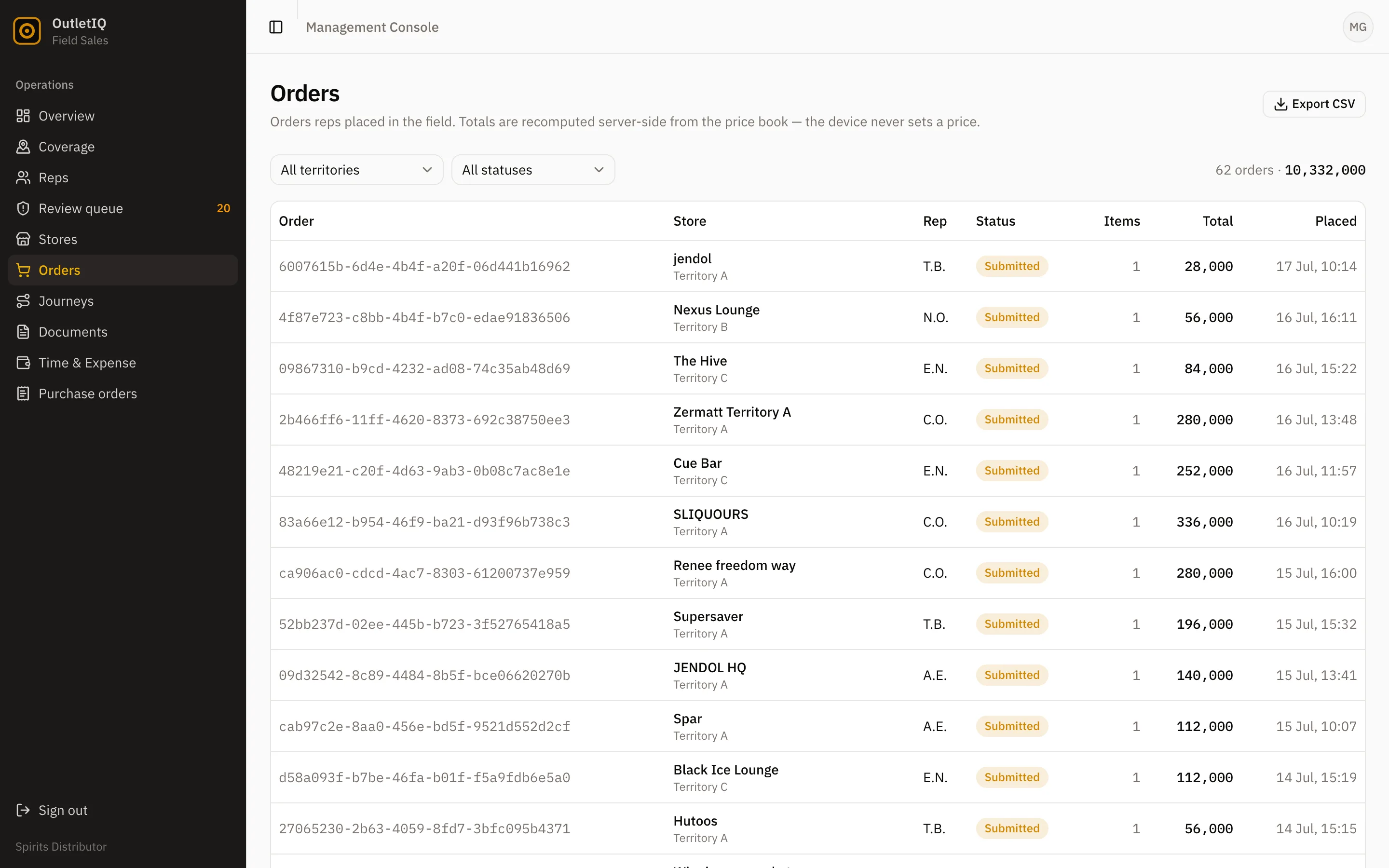
| Order capture in the outlet | Field sales software or an ERP mobile add-on | Yes. Catalogue and cart, server-side totals from the price book, idempotent submission, CSV export. |
| Approvals and purchase orders | ERP, finance tools or email | Yes for field side approvals. Multi-stage chains for expenses, leave, stock requests and LPOs, with a PDF on final sign-off. |
| Stock, warehouse and inventory | ERP or warehouse management system | No. Keep it in your ERP or WMS. |
| Invoicing, credit control and accounts | ERP or accounting software | No. |
| Delivery routing, drivers and proof of delivery | Delivery or route accounting software | No. OutletIQ routes are for sales reps, not delivery vehicles. |
| Van sales route accounting | Route accounting or DSD software | No. OutletIQ does not settle vans, print invoices or collect payments. |
| Excise, duty and licensing records | ERP or specialist compliance tools | No. |
OutletIQ rows reflect the features described on the OutletIQ homepage. Scope and integrations for a specific deployment are confirmed in a written quote.
How OutletIQ does it
Wine and spirits distribution adds pressure to every point above. Unit values are higher, so a wrong price or a phantom free case costs more. Listings are fought for, so proof that the range is on the shelf matters to the brand owner. And much of the trade is on premise, in bars, hotels and restaurants where signal is poor and the buyer has five minutes. OutletIQ was built for that kind of field operation, in drinks and wider FMCG.
What OutletIQ does not do. It is not an ERP. It does not manage your warehouse or stock levels, issue invoices, run credit control, plan delivery vehicles, settle van sales or keep excise and duty records. It also does not score shelf photos automatically with image recognition. If you need those jobs done, keep or buy the system that does them and connect OutletIQ to it. Orders already export to CSV, and integration with your existing systems is scoped as part of the quote.
High frequency categories like soft drinks and beer put the weight on coverage and speed: more calls per day, smaller orders, more outlets that need checking for chiller placement and availability. Journey plans with week and month views, carried forward audit answers and a one hand rep app all exist to shorten the call without losing the evidence. A mixed portfolio distributor can run one audit form for spirits and another for soft drinks, because forms are configurable.
If you are shortlisting, we have written sourced comparisons built from each vendor's own public pages: OutletIQ vs Repsly, OutletIQ vs Skynamo and a wider roundup of Repsly alternatives. For the general category, see retail execution software and field sales software.
Last reviewed September 2026.
Questions
Beverage distributor software is the set of systems a drinks distributor uses to sell, deliver and account for beer, wine, spirits and soft drinks. Field sales and retail execution software is the part your reps carry: it plans outlet visits, verifies they happened, records audits and promotions, and captures orders at the price your business set.
No. OutletIQ does not run your warehouse, stock, invoicing, delivery routes or route accounting. It covers the rep in the outlet and the manager at head office. If you already run an ERP or a distribution system, OutletIQ should sit alongside it, and integration is part of the scoping conversation.
Yes. The OutletIQ rep app is offline-first. It runs on a local database and queues every action in an outbox that syncs when signal returns, so a cellar bar or a rural route loses nothing.
Not in OutletIQ. The device never sets a price. Order totals are recomputed server-side from the price book, and submissions are idempotent, so a weak connection cannot create a duplicate order.
Yes. Store audits are configurable sectioned forms covering availability, shelf facings, competitor prices and promotions, with photos attached to the visit. Free stock and promotional lines are recorded against the outlet and the visit so a manager can see what went out and where it landed.
Four signals are cross-checked on every visit: GPS geofencing at the outlet, a 30-minute dwell check, mock-GPS detection and location-fix density. Anything suspicious is flagged with its reason and sent to the manager review queue with the photo evidence attached.
No. Duty, excise and licence records belong in your ERP or finance system. OutletIQ records the visit, the audit and the order.
OutletIQ is a monthly subscription quoted per operation. Team size and rollout scope move the number, so pricing is written against your actual deployment rather than published as a list.
Book a demo
A 20-minute walkthrough of the rep app and the manager console, then a straight conversation about whether OutletIQ fits your drinks distribution operation and what it should connect to.
Or email fionn@fmops.ie
Keep reading
What retail execution software is, what it has to prove, and how OutletIQ does it.
Read it →A plain definition of field sales software and the questions to ask before buying.
Read it →Six tools distributors shortlist instead of Repsly, sourced from each vendor's own pages.
Read it →How Skynamo and OutletIQ differ for UK and Ireland drinks and FMCG distributors.
Read it →The rep app, the manager console and the review queue, on one page.
Read it →